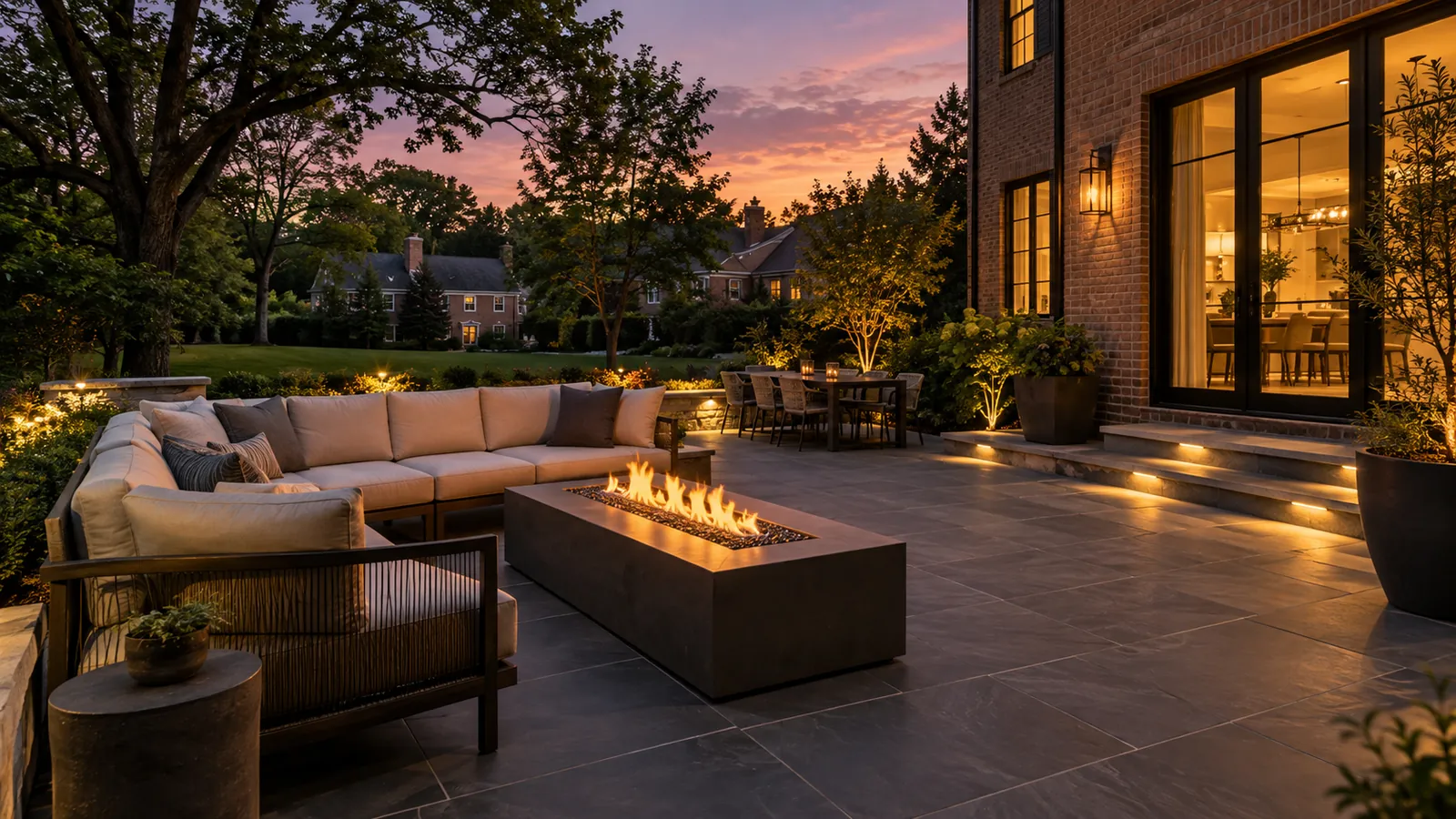
A new patio or retaining wall looks great in the afternoon — then disappears after sunset. In Maryland, where it is dark before 6 p.m. for much of the fall and winter, landscape lighting is what turns a weekend hardscape project into a space you actually use most evenings of the year.
This guide covers the lighting techniques that work best on patios, walls, steps, and walkways, how to choose fixtures and color temperature, the wiring basics every homeowner should understand, and why lighting is easiest and cheapest to install while the hardscape is being built.
Why Lighting Belongs in the Hardscape Plan
The most common lighting regret we hear is “we wish we had done it when the patio went in.” Once pavers, flagstone, or concrete are down, every step light and under-cap wall light means cutting, lifting, or drilling finished work. Planned up front, the same lighting costs far less and looks cleaner:
- Cable and sleeves run through the open base before the surface is set
- Wall-cap and riser lights are built into the courses, not surface-mounted later
- Transformer location and power are planned instead of improvised
- No visible wire runs across lawns, beds, or joints
That is why our hardscape contractor team treats lighting as part of the design, not an add-on after the crew leaves.
Lighting Techniques for Maryland Yards
1. Step and Riser Lighting
Small, low-glare fixtures recessed into stair risers or tucked under treads light each step without shining in anyone’s eyes. On sloped Montgomery County lots, this is the single most important light for safety — especially on stone or paver steps that can be slick with wet leaves in fall.
2. Wall-Cap and Hardscape Lighting
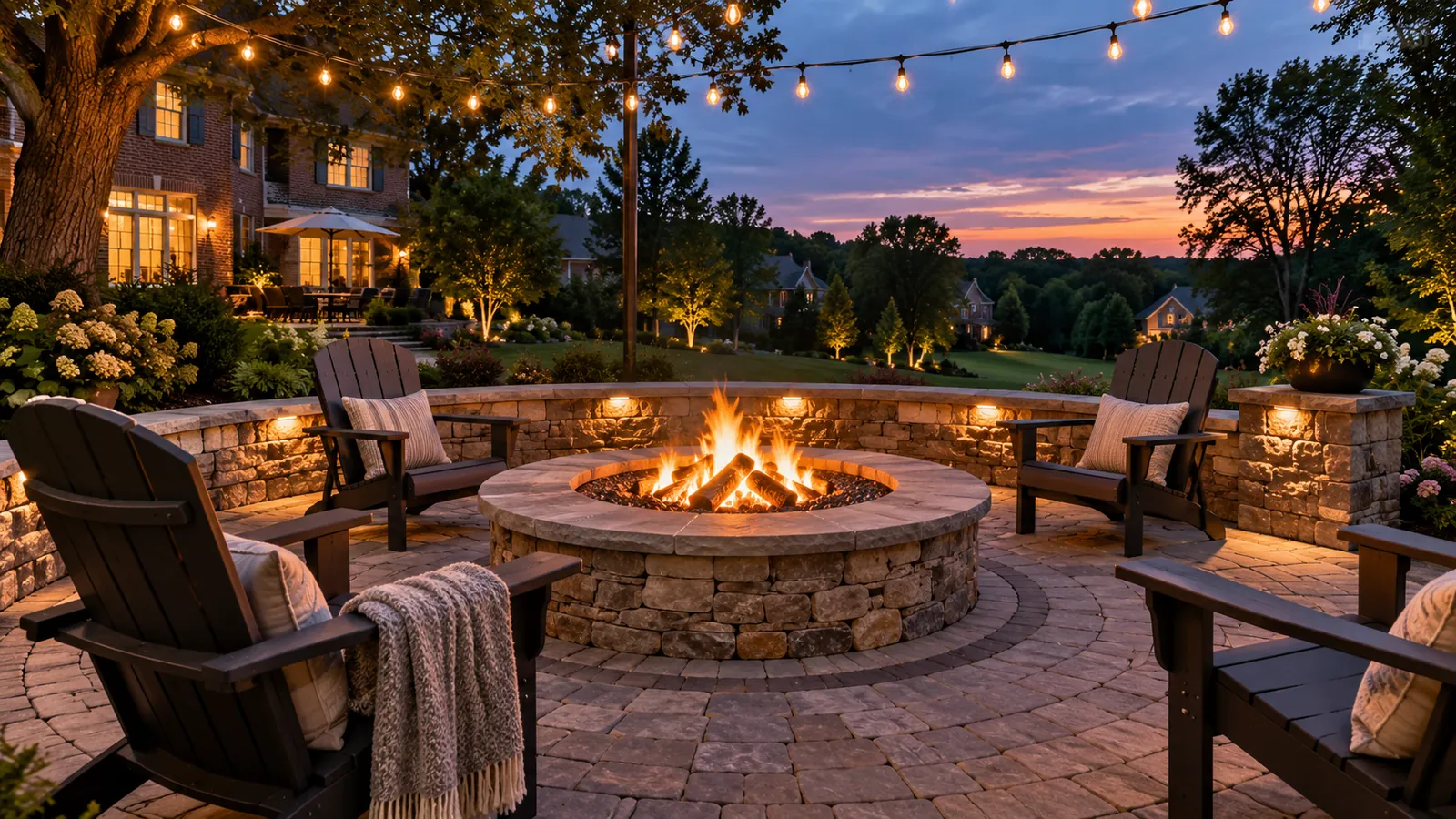
Slim LED bars mounted beneath the cap of a seat wall or retaining wall wash light down the face of the block. They define the edge of a patio, show off the wall’s texture, and add soft ambient light without a single visible fixture.
3. Path Lighting
Shielded path lights along walkways and driveways guide guests from the street to the door. Stagger fixtures on alternating sides rather than lining them up like a runway, and space them so the pools of light just meet.
4. Uplighting and Downlighting
Uplights at the base of trees, stone columns, or the house façade create depth and drama. Downlights mounted high in a mature tree (often called moonlighting) cast soft, natural-looking shadows across a patio or lawn and provide useful light without glare.
5. Grazing and Feature Lighting
Placing a fixture close to a textured surface — a natural stone wall, a stacked-stone fire pit, or a pillar — “grazes” it with light and highlights every edge and shadow.
Choosing Fixtures, Color Temperature, and Brightness
| Fixture | Typical use | Where it shines |
|---|---|---|
| Step / riser light | Safety, ambient | Stairs, landings, terraced patios |
| Hardscape (wall-cap) bar | Ambient, edge definition | Seat walls, retaining walls, kitchen counters |
| Path light | Wayfinding | Walkways, sidewalks, driveway edges |
| Spot / well light | Accent, uplighting | Trees, columns, house façade |
| In-grade / paver light | Marker, accent | Patio borders, driveway aprons, pool decks |
- Use integrated LED fixtures. According to the U.S. Department of Energy, residential LEDs use at least 75% less energy and last up to 25 times longer than incandescent lighting — a big deal for lights that run every night.
- Stay warm. Warm white light around 2700K–3000K flatters brick, stone, and plantings and feels far more inviting than cool, blue-white light.
- Less is more. A few well-placed, lower-output fixtures look better than a yard lit like a parking lot. Contrast is what makes features stand out.
- Choose solid metal housings. Brass and copper fixtures handle Maryland’s freeze-thaw winters and humid summers better than thin aluminum or plastic.
Be a Good Neighbor: Light Responsibly
Glare and light trespass are the fastest way to annoy neighbors on tight suburban lots. DarkSky International’s lighting principles boil it down to light that is useful, targeted, low-level, controlled, and warm-colored. In practice, that means shielded fixtures aimed down or at a specific feature, timers or dusk-to-dawn controls, and color temperatures of 3000K or lower.
Building a Patio or Wall This Season?
Ask us to include a lighting layout in your free estimate — it is far easier to wire before the surface goes down.
Get Your Free QuoteLow-Voltage Wiring Basics Homeowners Should Know
Nearly all residential landscape lighting today is low-voltage: a transformer plugs into a weatherproof, GFCI-protected outdoor outlet and steps 120-volt household power down to about 12 volts. A good installation gets these details right:
- Size the transformer with headroom — total fixture wattage should leave room to add lights later.
- Manage voltage drop — long runs lose voltage, so fixtures at the end get dimmer. Heavier-gauge cable and hub-style wiring keep brightness even.
- Bury cable and sleeve it under hardscape — direct-burial cable is commonly set about 6 inches deep in beds and lawns, and run through conduit beneath patios, walkways, and driveways so it can be serviced later.
- Use waterproof connections — gel-filled or sealed connectors prevent the corrosion that causes most flickering and dead fixtures.
- Add smart control — astronomic timers or photocells adjust automatically as Maryland’s sunset time shifts through the year.
Outdoor wiring is governed by the National Electrical Code (NFPA 70), which Maryland jurisdictions adopt and enforce locally. Any new 120-volt circuit or outdoor outlet should be installed by a licensed electrician, and line-voltage work typically requires a permit. We coordinate that work so the low-voltage system is ready to go the day the hardscape is finished.
Where to Add Lighting on Your Next Project
- Paver and stone patios — seat-wall bars, in-grade border lights, and step lights. See our paver patio, flagstone patio, and brick patio services.
- Concrete patios and walkways — conduit can be set before the pour for path and step lights. Explore concrete patios and concrete sidewalks.
- Retaining walls and terraces — under-cap lights on each tier turn a structural wall into a nighttime feature.
- Fire pits and outdoor kitchens — soft ambient light around the seating area, plus task lighting at the grill.
- Pool decks — low-glare marker lights along the deck edge for safer nighttime swimming. Learn more about pool deck installation.
- Gardens and front yards — uplit specimen trees and path lights paired with our landscape services.
Planning a bigger project? Our guide to documenting your yard before hardscaping makes a nighttime walk-around a smart addition — it shows exactly where you need light.
Caring for Landscape Lighting
- Trim plantings each spring so they do not swallow fixtures or block beams.
- Re-aim fixtures that get bumped by mowers, snow shovels, or pets.
- Clear leaves and debris from in-grade and well lights in fall.
- Reset timers after power outages if your controller lacks battery backup.
- Have the system checked if fixtures dim or flicker — usually a connection issue.
Frequently Asked Questions
Should landscape lighting be installed before or after a new patio?
Plan it before. The best time to run wire and sleeves for patio, step, and wall lights is while the base is open, before pavers, stone, or concrete go down. Retrofitting later is possible, but it often means cutting joints, lifting pavers, or settling for surface-run wire.
What is the difference between low-voltage and line-voltage landscape lighting?
Low-voltage systems use a transformer to step standard 120-volt household power down to about 12 volts, which makes fixtures and buried cable safer to work around and easier to adjust. Line-voltage (120-volt) lighting is used for some high-output or architectural applications and should be installed by a licensed electrician, typically with a permit.
What color temperature is best for outdoor lighting?
Warm white light around 2700K to 3000K suits most Maryland homes and gardens. It flatters brick, stone, and plantings, feels inviting, and aligns with DarkSky International’s recommendation to use warmer light (3000K or lower) to reduce glare and skyglow.
How deep is low-voltage landscape lighting cable buried?
Low-voltage cable is commonly buried about 6 inches deep, but requirements depend on the system and location. Under hardscape, we prefer to run cable through conduit or sleeves so it can be serviced later without disturbing the surface.
Does SiteDoctorMD install landscape lighting by itself?
We design and install integrated low-voltage lighting as part of our hardscape and landscape projects — patios, retaining walls, steps, fire pits, and walkways. Any new 120-volt circuit or outdoor GFCI outlet needed to power the transformer is handled by a licensed electrician.
What areas of Maryland does SiteDoctorMD serve?
SiteDoctorMD is based in Silver Spring and serves homeowners across Maryland, with a focus on Montgomery County, Prince George’s County, and Howard County. Contact us to confirm availability for your address.
Light Up Your Outdoor Space Anywhere in Maryland
From lighted steps and seat walls to glowing fire pit patios, SiteDoctorMD builds landscape lighting into hardscape designed for Maryland’s climate. Request your free, no-obligation estimate.